

Digital Colliers Daily Briefing — July 18, 2026
The frontier model market spent the past 48 hours absorbing a shock from Beijing, and the aftershocks are already reshaping US pricing strategy. Moonshot's release of Kimi K3 has forced a public reassessment of the compute-moat thesis, driven Anthropic to abandon a planned subscription downgrade of Claude Fable 5, and — in an unrelated but symbolically pointed reminder that hyperscale infrastructure remains fragile — Amazon Web Services spent Friday morning telling customers they owed sums up to $7.1 trillion. Today's briefing covers each in turn.
1. Moonshot's Kimi K3 lands in the top benchmark cluster and undercuts Opus 4.8 on price

What happened. Moonshot AI announced Kimi K3 on July 16, describing it as a 2.8-trillion-parameter model — what the lab is calling the first "open 3T-class" release, with weights due by July 27. The model is already live on kimi.com and via API at $3 per million input tokens and $15 per million output tokens, matching Anthropic's Sonnet tier and making it, as Simon Willison notes, the most expensive model any Chinese lab has shipped. Artificial Analysis puts K3 at 57 on its Intelligence Index — behind Claude Fable 5 (60) and GPT-5.6 Sol (59), ahead of Opus 4.8 (56) — and reports a per-task cost of $0.94, roughly half of Opus 4.8's $1.80. On the Arena.ai Frontend Code leaderboard, K3 took the top slot at 1,679, ahead of Fable 5 and GPT-5.6 Sol. DataCurve reported K3 debuting at #3 on DeepSWE, the first open-weights entrant with frontier-level scores there.
Why it matters. The technical story is not just the score line. As Latent Space's recap frames it, the strategic argument has shifted from "compute moat" to "efficiency stack": MoE routing, Moonshot's Mooncake serving infrastructure, and — most consequentially — Kimi Delta Attention, a fast-weights memory mechanism that Moonshot claims delivers up to 6× cheaper throughput at 1M context. If KDA holds up in wider deployment, long-context pricing dynamics change materially. Token efficiency remains contested: @theo argues K3's higher output-token consumption erodes the headline cost advantage against GPT-5.6 Sol, and the model currently ships with only one reasoning intensity ("max"), which produced a 25-cent pelican SVG in Willison's test.
Who is affected. Anthropic and OpenAI face the most direct pressure — David Sacks publicly framed K3's Frontend Code Arena lead as an argument against US data-center constraints, and Chamath Palihapitiya flagged the widening spread between cheap and premium tokens. Enterprises running high-volume inference now have a credible open-weight option in the same capability tier as closed frontier models, though at 2.8T parameters, K3 is not a local-inference model for most users. Downstream, the harness-and-scaffolding layer — memory systems, MCP tooling, agent orchestration — becomes the more defensible moat, a point made by both @jmorgan and @Yuchenj_UW.
What to watch next. The July 27 weights drop, independent verification of KDA's long-context claims, and whether Moonshot ships a smaller companion model for cheaper inference — a pattern DeepSeek established with its planner/implementer split. Also watch ARC-AGI-2 scores when they arrive; BenchPress estimates are already circulating.
Sources:
- HN · 332↑ Kimi K3, and what we can still learn from the pelican benchmark — Hacker News
- not much happened today — smol.ai News
- The 15 Most INSANE Things Created by KIMI K3 ( KIMI K3 Use Cases) — YouTube · The AI Grid
- [AINews] not much happened today — Latent Space
- Quoting Kimi K3 — Simon Willison
- Kimi K3 CRUSHED Fable — YouTube · Wes Roth
2. Anthropic reverses the Fable 5 subscription downgrade

What happened. Anthropic announced via its @claudeai account that beginning July 20, Claude Fable 5 will be included in all Max and Team Premium plans at 50% of standard usage limits. Pro and Team Standard users will retain access through usage credits and receive a one-time $100 credit. This is a direct reversal of Anthropic's earlier plan — which had triggered what Simon Willison dubbed the "Fablepocalypse" — to strip Fable 5 from subscriptions and route it exclusively through API pricing, a move Anthropic had justified on compute-capacity grounds.
Why it matters. The timing is difficult to read as anything but competitive. Willison writes plainly that "the competition from GPT-5.6 Sol (and maybe to a lesser extent Kimi 3) made untenable Anthropic's plan," posing the obvious question: "Why pay $100 or $200/month for a subscription plan that doesn't include Anthropic's best model?" With K3 at roughly half of Opus 4.8's per-task cost and OpenAI's Sol tier included in ChatGPT subscriptions, the frontier subscription market no longer tolerates a premium tier without a premium model. The 50% limits and paused capacity concerns suggest Anthropic is absorbing a real infrastructure hit to hold the line, and Willison speculates the company may have to slow training work to free GPUs for inference — a tradeoff worth watching.
Who is affected. Max subscribers ($200/month) and Team Premium customers get the most immediate benefit and can stop rationing Fable usage. Pro users get a $100 credit but remain on metered access. Anthropic's cloud partners — AWS, Google Cloud — will need to accommodate the shifted serving load. Competitively, this validates the price-war thesis that the K3 release ignited: frontier labs cannot defend premium pricing without their frontier models sitting inside the tier.
What to watch next. Whether the 50% limits hold or get tightened under load; any signals about Anthropic's training-versus-serving capacity allocation; and how OpenAI and Google respond on subscription bundling. If Anthropic quietly slows the cadence to Fable 6 to keep serving capacity intact, that becomes the more consequential story.
Sources:
- Claude make Fable 5 permanent — Simon Willison
- Anthropic says Claude Fable 5 will be included in Max and Team Premium plans at 50% of limits from July 20 and via usage credits for Pro and Team Standard users (Claude/@claudeai) — Techmeme
- AI News: Claude's New Browser, Spotify Gets AI & OpenAI's New Hardware — YouTube · Matt Wolfe
3. AWS billing subsystem shows customers phantom charges up to $7.1 trillion
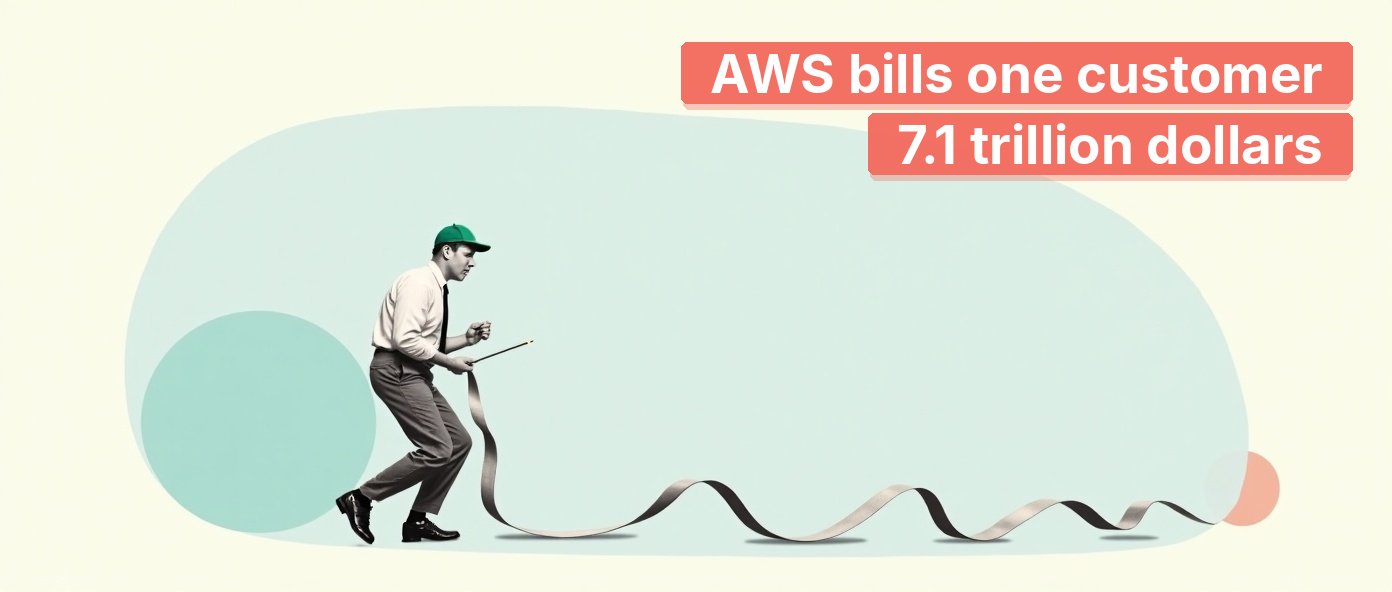
What happened. Beginning at 10:38 pm EDT on July 16, AWS's estimated billing subsystem began displaying grossly inflated charges to customers globally. Per Wired's reporting, Bill Radjewski, whose CollegeFootballData.com account has averaged $0.01 per month for six years, received an alert projecting his August 1 bill at more than $3 billion. Other users reported figures of $22 billion, $75 billion, and $110 billion; one Reddit post showed a "cost and usage overview" of $7.1 trillion since July 1 — more than twice Amazon's market capitalization. AWS attributed the failure to "an issue with unit pricing within the estimated billing computation subsystem," began rolling back the offending change, and paused estimated billing computations. The company said no customer action is required and expects resolution by the weekend.
Why it matters. The incident is operationally minor — no workloads were affected and no invoices were actually collected — but symbolically loud. AWS remains the load-bearing floor of a large fraction of the internet, and a global failure in its pricing computation, however cosmetic, illustrates how much of the cloud stack depends on subsystems that rarely get the visibility of compute or storage. The Hacker News thread on the incident drew over 1,300 combined upvotes across two posts, indicating how quickly billing anxiety translates into engineering-community attention. It is also a reminder that "estimated billing" and "actual billing" are separate pipelines — a distinction most customers do not think about until one of them breaks.
Who is affected. Every AWS customer who checked the billing console during the window, most acutely small-account users for whom the deltas were absurd on their face. Finance teams at larger organizations will have spent Friday morning reconciling, and AWS support and account-management staff are absorbing the inbound. No downstream financial systems appear to have acted on the bad data.
What to watch next. The postmortem — AWS has not specified what the unit-pricing change was — and whether the incident prompts customers to add independent billing-alarm validation. Also worth watching: whether any automated FinOps tooling triggered on the phantom numbers before the rollback completed.
Sources:
- AWS Billing Glitch Hits Customers With Billion-Dollar Fees — Wired
- HN · 203↑ Ask HN: Any AWS billing issues known? Amazon forecast of 3 billion dollars — Hacker News
- HN · 1172↑ AWS: Inaccurate Estimated Billing Data – $1.7 billion — Hacker News
The through-line across today's stories is pressure on incumbents. Moonshot's K3 has forced US labs to compete on both capability and price at the same time, and Anthropic's Fable 5 reversal — announced within 48 hours of the K3 release — is the first visible operational consequence. Meanwhile, AWS's billing incident is a reminder that the infrastructure underneath all of this is not immune to its own kind of correction, even if today's correction was measured in trillions of imaginary dollars rather than lost workloads.