

Digital Colliers Daily Briefing — July 5, 2026
Three stories today capture the widening gap between AI's marketing surface and its operational reality: a Chinese hyperscaler formally shutting a US coding agent out of its workforce, a Wyoming utility halting all data center discharges after a Meta contractor contaminated municipal reuse water, and Guardian reporting that £20 billion of a headline UK-OpenAI investment package appears to have been hypothetical. Each event pressures a different pillar of the current AI build-out — cross-border tooling, physical infrastructure, and industrial-policy credibility.
1. Alibaba blocks Claude Code as Anthropic's covert user-identification surfaces

What happened. Alibaba will bar employees from using Anthropic's Claude Code starting July 10, according to reports summarized by TechCrunch. The company has classified the tool as high-risk software and directed developers to its in-house Qoder assistant instead. The move follows a Reddit disclosure that a version of Claude Code contained code capable of covertly identifying Chinese users. Anthropic's Thariq Shihipar, posting on X, described it as "an experiment we launched in March that was meant to prevent account abuse from unauthorized resellers and protect against distillation," adding that the team had "landed stronger mitigations since then" and had intended to remove the mechanism.
Why it matters. Anthropic already prohibits Chinese companies and their foreign subsidiaries from using its models, but the Alibaba ban is the first prominent case of a Chinese hyperscaler formally reciprocating at the employee-policy level. It signals that Western coding agents are now a governance-tracked category inside Chinese enterprises, on par with restricted cloud services. The covert-identification detail also complicates Anthropic's positioning with global enterprise buyers who expect transparent client-side behavior from developer tools.
Who is affected. Alibaba's engineering organization — one of the largest single developer bases in the world — pivots decisively toward Qoder. Anthropic loses any residual gray-market revenue from Chinese resellers and takes a reputational hit on trust and telemetry practices. Domestic Chinese coding-assistant vendors, including Alibaba's own Qoder and rivals from Zhipu, DeepSeek, and ByteDance, gain a captive enterprise pipeline.
What to watch next. Whether Tencent, ByteDance, and state-owned enterprises issue parallel bans; whether Anthropic publishes a technical post-mortem on the March experiment; and whether US export-control regulators cite the incident as justification for tighter model-access rules.
Sources:
2. Cheyenne halts all data center cooling discharges after Meta contractor contamination
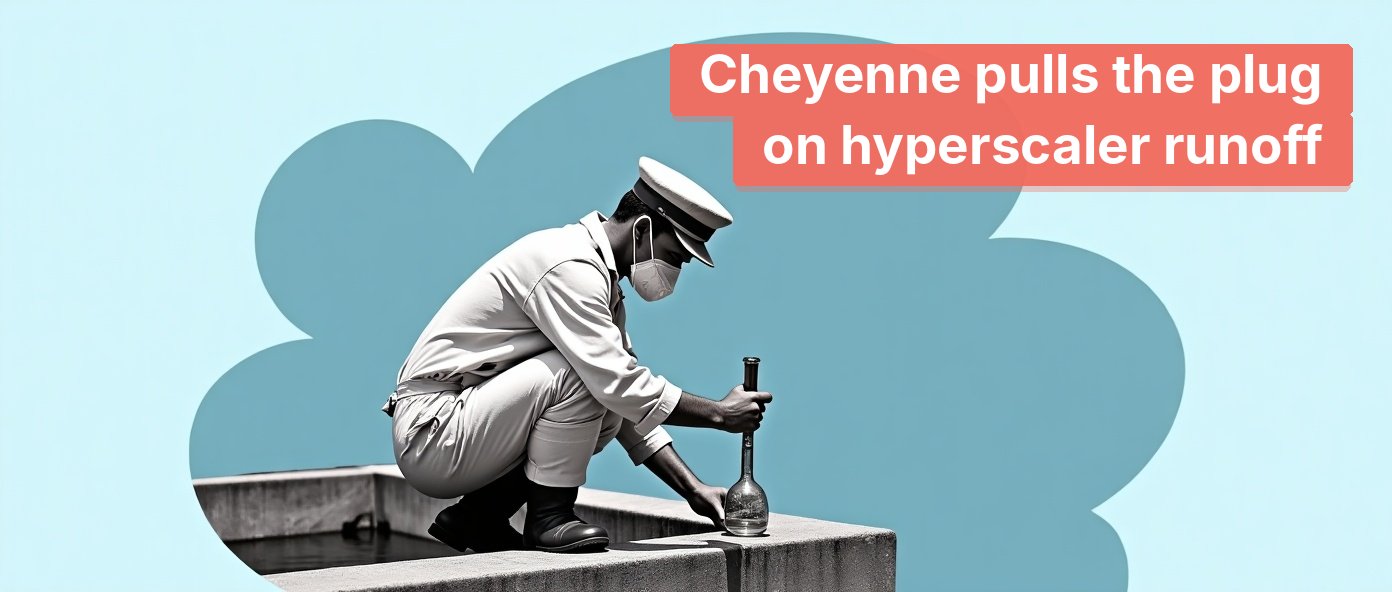
What happened. The Cheyenne Board of Public Utilities has suspended acceptance of industrial wastewater from every data center connected to city services after tracing Cupriavidus gilardii, a metal-resistant bacterium, in the city's reclaimed water to Goat Systems LLC, the entity Meta uses to build its Cheyenne campus. According to Tom's Hardware, the contamination disabled two water reclamation plants and pushed the reuse system offline for months of cleanup. The Board revoked Goat Systems' fill-and-flush privileges on March 24 and later widened the suspension to cover closed-loop discharges as well. Frank Strong, the Board's engineering and water resource division manager, told the Wyoming Tribune Eagle that the fill water had been sold to the contractor by the Board itself and that lab staff caught the bacterium in February during routine fecal-bacteria sampling. Meta says its general contractor Fortis has stopped discharging and is hauling wastewater offsite; testing at the Dry Creek and Crow Creek facilities cleared in late June.
Why it matters. Microsoft and Nvidia have marketed sealed liquid loops — Nvidia's Rubin platform uses a 75% water, 25% propylene glycol coolant — as a near-zero-water alternative to evaporative cooling. As Tom's Hardware notes, that framing ignores the one-time fill-and-flush commissioning step, which produces a discharge that leaves the site before the loop is sealed. Strong warned that closed-loop systems can also carry glycol and other chemicals municipal plants aren't built to process, and that Cheyenne's reuse water is sprayed on parks and golf courses, raising aerosol concerns. This is the first documented case where a municipal utility has recharacterized "sealed loop" cooling as a live discharge risk.
Who is affected. Meta's Cheyenne build faces schedule uncertainty, as do other operators — Microsoft and Google both have Wyoming footprints — still under construction on city services. Hyperscaler siting teams now face a new municipal-relations variable. Regulators in other reuse-water jurisdictions (Arizona, Nevada, Texas) are likely to reread their pretreatment rules.
What to watch next. Whether the Cheyenne Board publishes formal criteria for reinstating discharges; whether Meta discloses schedule impact in its next earnings commentary; and whether the EPA or state regulators elsewhere issue guidance on fill-and-flush handling.
Sources:
3. Guardian: £20B of UK Stargate Cobalt pledge was hypothetical

What happened. The Guardian's Aisha Down reports that a source has characterized the 2025 UK-and-OpenAI-touted plans for a roughly £20 billion Stargate data center at the Cobalt site in North Tyneside as a PR stunt. According to the report, neither OpenAI nor its infrastructure partner Nscale visited the Cobalt site or lodged planning forms with local authorities. The £20 billion figure represents the bulk of the £30 billion in "potential" AI investment ministers publicized alongside the announcement.
Why it matters. The Cobalt announcement was a centerpiece of UK industrial-policy messaging on AI compute sovereignty. If the largest single line item was aspirational — with no site diligence and no planning submissions — the credibility of the broader £30 billion headline collapses, and with it the government's ability to cite Stargate UK as evidence of delivery. It also sets a precedent for how the press should treat hyperscaler MOUs that arrive bundled with ministerial press conferences.
Who is affected. UK ministers who staked political capital on the announcement; OpenAI and Nscale, which now face scrutiny over whether their UK commitments are contractual or promotional; North Tyneside Council, which was positioned as a beneficiary; and rival UK sites — including those pursued by CoreWeave, AWS, and Microsoft — that may now be re-evaluated against a more skeptical baseline.
What to watch next. Responses from OpenAI, Nscale, and the Department for Science, Innovation and Technology; any updated planning filings at Cobalt; and whether Parliament's science and technology committee opens an inquiry into how the figures were validated before publication.
Sources:
Together, today's stories mark a shift from AI narrative to AI accounting. Alibaba's ban and Anthropic's covert-identification episode show that the tooling layer is fragmenting along geopolitical lines faster than vendors will publicly admit; Cheyenne's suspension shows that the physical substrate of AI compute is being audited by local regulators who don't accept marketing categories at face value; and the Cobalt disclosure shows that press-conference gigawatts and billions require the same due diligence as any other capital claim. The build-out continues, but the room for unverified assertions is narrowing.