

Digital Colliers Daily Briefing — June 13, 2026
The center of gravity in tech shifted hard this week toward state power and capital concentration. A late-Friday US government directive forced Anthropic to pull its two most capable models off the market worldwide, SpaceX's $75 billion Nasdaq debut produced the first paper trillionaire and revalued a rocket company as an AI infrastructure play, and a Wired investigation laid bare the dysfunction inside Meta's 6,500-person Applied AI unit. Together they sketch a market in which sovereign discretion, private capital, and labor friction are all moving on the same timeline.
1. Commerce Department Yanks Fable 5 and Mythos 5 Off the Market

What happened. At 5:21 p.m. ET on Friday, Anthropic received a Commerce Department export-control directive barring access to Claude Fable 5 and Mythos 5 by any foreign national, anywhere — including foreign-national Anthropic employees. Unable to filter to that scope in real time, Anthropic disabled both models for every customer worldwide. Simon Willison documented the cutoff hitting the public API at 6:59 p.m. Pacific, with calls returning a 404 directing users to fall back on Opus 4.8. Vercel suspended Fable 5 on its AI Gateway shortly after. Anthropic's statement says the order rests on a demonstrated non-universal jailbreak — essentially, prompting the model to analyze a codebase and surface flaws — and notes the same capability is available from other publicly deployed models, including OpenAI's GPT-5.5. An administration official told Axios the pause was requested to give the "national security apparatus" several weeks to "harden" against the technique.
Why it matters. This is the first time the US government has used export-control authority to pull a deployed frontier model offline globally. The legal mechanism — controlling access by foreign nationals everywhere — is effectively impossible to comply with selectively, so the practical floor of the directive is a worldwide kill switch. Anthropic, while complying, publicly disputes both the technical basis and the procedural fairness, writing that applying this standard industry-wide "would essentially halt all new model deployments."
Who is affected. Every Fable 5 and Mythos 5 customer, from claude.ai users to Claude Code, the API, and downstream platforms like Vercel's AI Gateway. Enterprise partners announced in recent weeks — TCS's 50,000-employee rollout and the DXC alliance targeting regulated industries — now face an availability question on their highest-tier model. Competitors with frontier offerings, particularly OpenAI, gain near-term commercial oxygen. Longer term, as one commenter cited approvingly across the discourse put it, the precedent reframes closed-API dependency as sovereign risk.
What to watch next. Anthropic promised more technical detail within 24 hours; the substance of the underlying jailbreak report will determine whether this looks like a defensible safety call or a discretionary one. Watch for any move toward a statutory framework versus continued case-by-case directives, for how Anthropic's IPO timeline absorbs the disruption, and for whether Beijing tightens release policy on Chinese open-weight models in response.
Sources:
- [HN · 2315↑] Statement on US government directive to suspend access to Fable 5 and Mythos 5 — Hacker News
- Claude Fable 5 access suspended on AI Gateway — Vercel Changelog
- [HN · 245↑] There is a shadow hanging over this Fable thing — Hacker News
- Statement on the US government directive to suspend access to Fable 5 and Mythos 5 — Simon Willison
- Anthropic shuts down Fable, Mythos models following Trump admin directive — Ars Technica
- [HN · 250↑] We've suspended access to Claude Mythos 5 and Claude Fable 5 — Hacker News
2. SpaceX Prices at $135, Closes at $160.95, and Mints the First Trillionaire

What happened. SpaceX priced 555.6 million shares at $135 to raise $75 billion — the largest IPO on record — and opened at $150 on Nasdaq under the ticker SPCX. Shares closed at $160.95, up roughly 19 percent, with intraday gains touching 30 percent. The close put SpaceX's market capitalization near $2.1 trillion against a $1.77 trillion offer valuation, and pushed Elon Musk's paper net worth above $1 trillion, per Bloomberg and Forbes tallies cited by Wired. Per TechCrunch's tracking of the S-1, SpaceX lost $4.9 billion on $18 billion in 2025 revenue, has lost more than $37 billion since inception, and Musk retains roughly 85 percent of voting power. Goldman Sachs and Morgan Stanley led an underwriter syndicate that collected about $500 million in fees, according to the Wall Street Journal. Roughly 4,400 employees become millionaires on paper.
Why it matters. The valuation is not principally a bet on Falcon, Starship, or Starlink. As Big Technology's Alex Kantrowitz notes, SpaceX now ascribes $26.5 trillion of a claimed $28.5 trillion total addressable market to AI — a business line it did not have a year ago. The pre-IPO compute deals tell the same story: Anthropic at a reported $1.25 billion per month and Google at $920 million per month, both buying capacity from a rocket company. Retail investors took an estimated low-20-percent share of the offering, well above the typical 5–10 percent, and placed more than $100 billion in orders. That distribution pushes venture-style risk onto public markets, and SpaceX will land in index funds regardless of individual conviction.
Who is affected. Long-time SpaceX employees with options; SPV holders facing lock-ups and opaque fees; Tesla shareholders, after COO Gwynne Shotwell mused on CNBC that a Tesla–SpaceX merger "might make Elon's life a little easier"; and the AI infrastructure market broadly, where SpaceX is now a credible compute counterparty. Anthropic and Google's lease durations remain disputed publicly, which is itself a data point about how tight frontier compute supply is.
What to watch next. Whether Shotwell's merger comment was a trial balloon; how SpaceX deploys IPO proceeds against its space data center plans, where Colossus 1 reportedly had to be rented out after latency issues; lock-up expirations; and whether the OpenAI and Anthropic public offerings now in view price against SpaceX's AI-multiple framework.
Sources:
- SpaceX is now a public company valued for its AI potential, so what comes next? — Ars Technica
- SpaceX's massive IPO: all the latest news — The Verge AI
- Elon Musk is the world's first trillionaire — The Verge AI
- SpaceX IPO: Live updates on everything you need to know — TechCrunch AI
- Elon Musk Is the World's First Trillionaire — Wired
- SpaceX's Valuation Is Crazy. Maybe That's A Feature? — Big Technology
3. Inside Meta's Applied AI Unit: 'Draftees,' 50-to-1 Managers, and a Livestream Meltdown
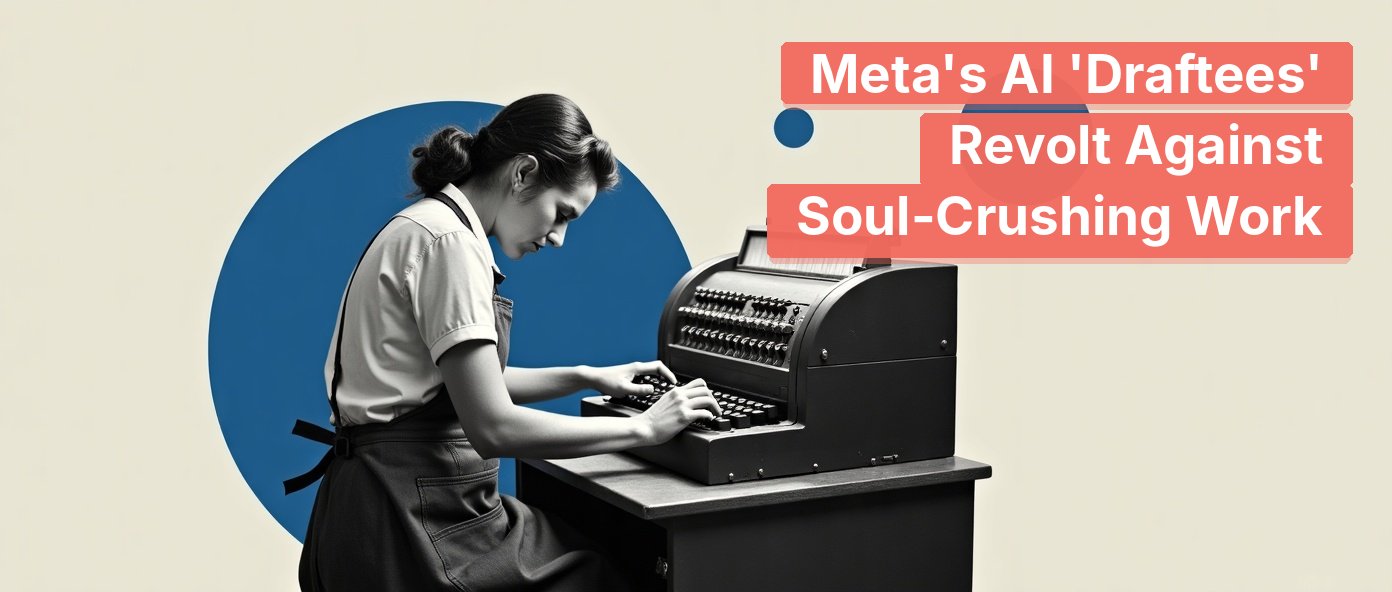
What happened. Wired, in reporting echoed by TechCrunch, detailed a deteriorating situation inside Meta's Applied AI (AAI) team, a roughly 6,500-person unit formed in March to feed training and evaluation data to Meta Superintelligence Labs. On an employee livestream this week, an attendee interrupted a technical talk with an expletive-laden tirade and asked presenters to relay to a senior AI executive that he was "a piece of shit." Three current employees described the work — generating coding puzzles and evaluation prompts — as "soul-crushing" and "the gulag," and said many were assigned with a join-or-leave ultimatum, calling themselves "draftees." Manager-to-report ratios reached 50:1 on some teams. Separately, more than 1,600 employees have signed a petition against a program that collects clicks and keystrokes from US staff to generate training data; Meta has allowed 30-minute pauses and case-by-case exemptions. In a Friday memo, Mark Zuckerberg acknowledged "mistakes," pledged no further mass layoffs this year, promised tighter span-of-control limits, restored assigned desks in many offices, and floated a July 14–16 companywide AI hackathon — which Wired reports drew immediate internal pushback as employees argued they lack the bandwidth after last month's 8,000-person cut.
Why it matters. AAI is one of the largest single AI organizational buildouts in the industry, and it is structurally downstream of Alexandr Wang's $14.3 billion Scale AI acquisition. Zuckerberg's reported rationale for using internal staff over contractors — that Meta employees are "significantly higher" intelligence than third-party labelers — only works if those employees stay engaged. The reporting suggests the opposite is happening at the moment Meta most needs throughput on training data to close ground on frontier competitors.
Who is affected. AAI engineers and PMs reassigned from product work; Maher Saba, the AAI lead, and CTO Andrew Bosworth, to whom the unit reports; Instagram and data center engineering teams absorbing spillover stress, as Chief Product Officer Chris Cox acknowledged on an Instagram all-hands; and Meta's recruiting pipeline, where the "draftee" framing will be hard to scrub.
What to watch next. Attrition data once equity vesting windows allow exits; whether the span-of-control changes actually reduce the 50:1 ratios; the fate of the keystroke-monitoring program under continued petition pressure; and whether the next Llama-family release shows the benefits of all this human-generated training data — the only outcome that retroactively justifies the organizational cost.
Sources:
- 'Tell Him He's a Piece of Shit': Meta's New AI Unit Is a Total Mess — Wired
- Sources detail frustration inside Meta's Applied AI team, formed in March to support Superintelligence Labs, over menial projects, "soul-crushing" work, more (Wired) — Techmeme
- Meta's months-old AI unit is a soul-crushing gulag, say the engineers stuck inside it — TechCrunch AI
- Meta Employees Absolutely Hate Mark Zuckerberg's Plan for a Companywide AI Hackathon — Wired
The three stories rhyme more than they diverge. A government can, on a Friday evening, deprecate the most capable commercial model in the market by executive directive; public markets can simultaneously absorb a $75 billion offering whose thesis assumes uninterrupted AI demand; and the company spending most aggressively to compete on frontier models is discovering that you cannot conscript your way to morale. Each event raises the same underlying question — who actually controls the inputs to frontier AI, whether those inputs are policy discretion, capital, or human labor — and none of the answers favor the incumbent assumption that the market alone will decide.